
Anyone can call themselves a fire risk assessor
There is no single licence to hold before calling yourself a fire risk assessor. The law requires competence, but does not hand out a badge, so the burden falls on you to judge it. Here are the questions worth asking before you appoint anyone, and why the cheapest quote is rarely the right one.
Waking watch: when it earns its cost, and when it does not
A waking watch is meant to be a bridge, not a destination. Yet for many buildings it has become a permanent, expensive fixture. Here is what a waking watch is actually for, when it is the right call, and how to tell whether yours should have been replaced by an alarm a long time ago.
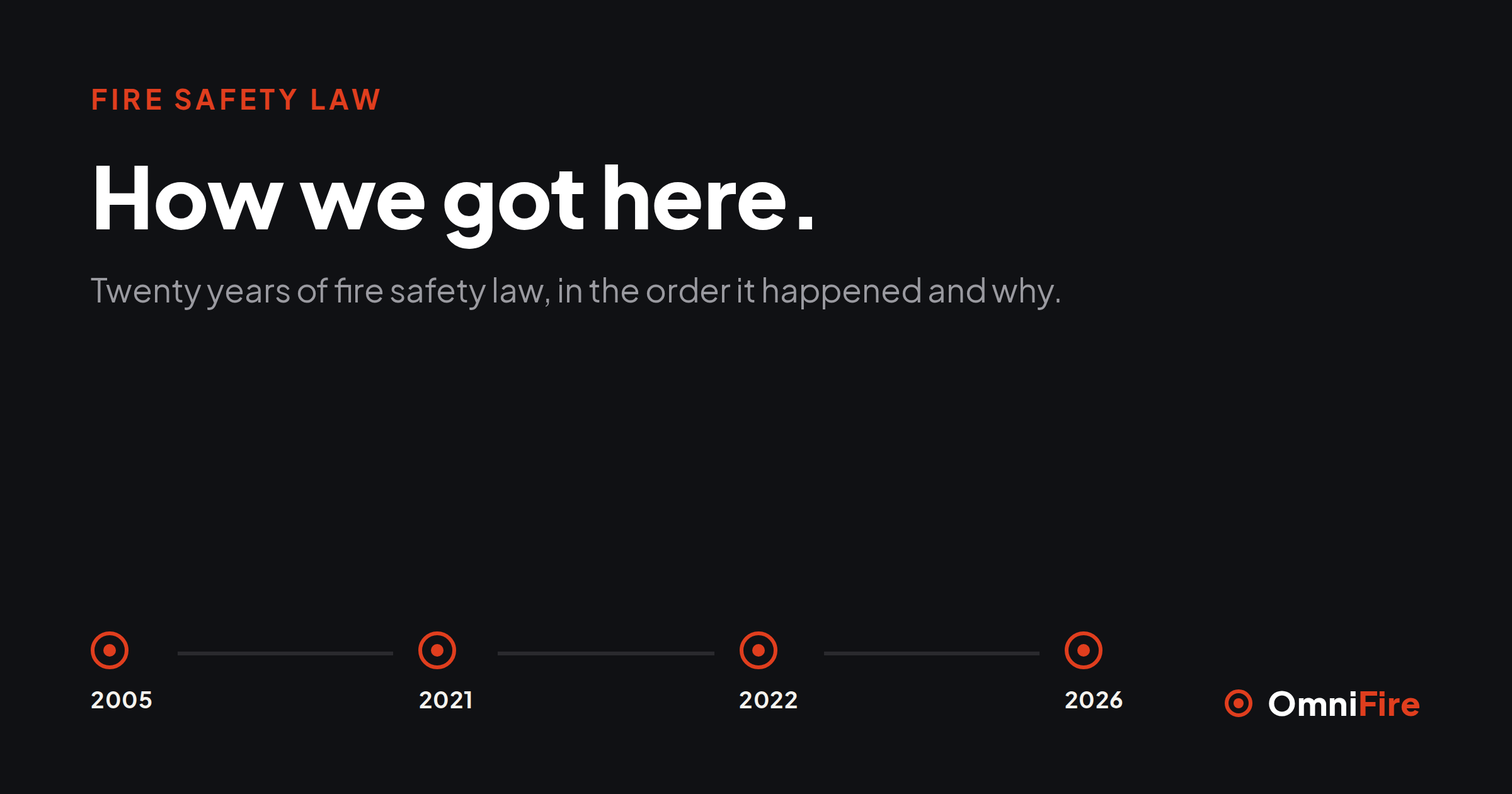
From the Fire Safety Order to today: the fire safety law timeline
Fire safety law can feel like a pile of overlapping rules that arrived from nowhere. It did not. It arrived in a sequence, each piece answering a problem the last one left open. Understanding the order makes the whole thing far easier to hold in your head. Here is the timeline.
Stay put or evacuate: what your building's fire strategy actually means
Every residential block has a fire strategy, and it decides what residents are told to do when the alarm goes: stay in their flat, or leave. It is one of the most important things about your building and one of the least understood. Here is what it means and why it matters.
The safety case report in plain English: what higher-risk buildings actually need
If your building is 18 metres or more, or seven storeys or more, with at least two flats, it is a higher-risk building, and someone has to produce a safety case report. The phrase sounds daunting. The idea underneath it is simple. Here is what it means and what it asks of you.
Law versus guidance: what you must do, and what is only recommended
Fire safety is a mix of hard legal duties and recommended good practice, and the two are constantly confused. Knowing which is which changes what you have to do, what you can decide, and where you can spend sensibly. Here is how to tell them apart.
When does your fire risk assessment need to be reviewed? What the law actually says.
The Regulatory Reform (Fire Safety) Order does not say annual. It says review when the assessment is no longer valid — a standard that can be triggered at any point by a change to the building, its use, or its occupancy. For managing agents with active portfolios, understanding the difference between the calendar-based approach and the legal standard matters.
What is a Building Assessment Certificate and is your building going to need one?
The Building Safety Regulator is issuing Building Assessment Certificates and calling buildings in for assessment in priority order, starting with those over 30 metres. For Accountable Persons and Principal Accountable Persons, the question is not whether the assessment is coming — it is whether the safety case and evidence framework are in a state that would stand up to scrutiny when it does.
The independence problem: why your fire risk assessor and your contractor should not be the same organisation.
When the same organisation carries out your fire risk assessment and recommends your remediation works, the advice is not independent — even when individuals are acting in good faith. The conflict is structural, not personal. Here is what independent oversight changes, and why it matters for managing agents procuring fire safety services.
Repair or replace? The fire door question that costs thousands.
The government’s August 2025 fire door guidance update was clear: existing doors do not need to meet new-build standards if they are still functional. For managing agents sitting on large survey recommendation lists, understanding the difference between what is legally required and what a contractor’s accreditation route produces can save significant cost and produce a stronger compliance position.
Residential PEEPs are here. What managing agents actually need to do now.
The Fire Safety (Residential Evacuation Plans) (England) Regulations 2025 came into force on 6 April 2026, and a lot of buildings still aren't on top of them. If you're a managing agent, freeholder or RMC, the duty to plan for residents who can't evacuate unaided now sits with you. Here's what's actually required, which buildings are caught, and how to catch up calmly if you're behind.